Can You Have Multiple Vision Boards? The Honest Truth

The question “can you have multiple vision boards?” comes up again and again in our annual vision board-making workshop, especially for people who are reflective, creative, and juggling many inner and outer worlds at once.
If you care deeply about your work, your relationships, your wellbeing, and your sense of purpose, one board can sometimes feel too small to hold it all.
At the same time, I totally understand if you’re feeling a quiet worry underneath: Will having more than one vision board dilute my focus rather than support it?
We approach visioning as a practice of listening rather than forcing clarity. So instead of giving you a rigid rule, let’s explore the question with nuance, real science, lived experience, and intuition - helping you decide what truly serves you.
What Exactly Is a Vision Board?
A vision board is often described as a visual representation of what you want your future to look like.
Traditionally, it’s a collage of images, words, symbols, and textures that reflect your hopes, goals, or dreams. And many people create them using magazines, digital tools, or photographs they already associate with success or happiness.
At a deeper level, however, a vision board is not just about what you want. It’s about how you want to feel as you move through your life. This distinction matters more than most people realise.
In our work, we see vision boards less as goal-setting tools and more as mirrors. They reflect your inner landscape - your longings, tensions, values, and sometimes even things you haven’t yet put into words.
A vision board can function as:
A sense-making tool during periods of transition
A way to reconnect with creativity when logic feels exhausted
A visual anchor for qualities you want to cultivate
A gentle reminder of direction rather than a checklist of achievements
When approached this way, vision boards stop being about control and start becoming about deepening your relationship with yourself, your time, and your energy.
Do Vision Boards Actually Work? What Does Science Say About Them?
Vision boards are often dismissed as “woo woo” or superstitious thinking. At the same time, millions of people swear by them. The truth, as usual, sits somewhere in between.
From a psychological perspective, vision boards can work through several mechanisms.
First, there is mental imagery. When you regularly see images connected to certain experiences or qualities, your brain becomes more familiar with them. This familiarity can influence perception, attention, and behaviour over time.
Second, vision boards can support goal priming. Seeing frequent reminders of what matters to you the most can subtly affect the decisions you make, even when you’re not consciously thinking about them. You might notice opportunities you would otherwise overlook or ignore.
However, research also shows something important: visualisation alone is not enough. Some studies suggest that imagining outcomes without engaging with the effort, uncertainty, or emotional reality involved can actually reduce motivation.
This is where many vision boards fall short.
When a board is created purely from a mental or aspirational place - copying images of lifestyles, bodies, or careers without sensing into what they represent (i.e. identify shifting) - it can become disconnected from lived experience. It may look inspiring, yet feel strangely flat over time.
In contrast, practices that involve embodied reflection - tuning into emotions, needs, and inner signals - tend to create more sustainable long-term change. When a vision board reflects felt qualities rather than surface-level goals, it becomes less about fantasy and more about orienting yourself in a more aligned way.
This is why some people say vision boards “don’t work”, while others experience moments of uncanny alignment. Often, the difference lies not in the board itself, but in how it was created.
Can You Have Multiple Vision Boards?
Yes, you can have multiple vision boards. But the more important question is whether having multiple vision boards serves you or fragments you.
One of the first things to consider is time horizon. Not all visions live on the same timescale.
You might have:
A long-term vision board that reflects your broader life direction
A shorter-term board focused on a specific year or season
A situational board related to a particular project or transition
For example, in our annual visioning workshop, we invite participants to reflect deeply on the year that has passed. Only after harvesting insights and learnings do we create a vision board for the year ahead.
If you’re looking for an instructional vision board-making workshop designed to be no-pressure and supportive, check out our self-paced online Visioning 2026 Workshop.
This alone can justify having more than one board: one that holds your longer-term orientation, and one that speaks to the chapter you’re currently in.
Another reason multiple vision boards can make sense is domain clarity. Some people experience their lives as having clearly differentiated spaces.
You might feel a strong distinction between:
Your work in an organisation or volunteering
Your personal life and relationships
If you’re, for instance, deeply committed to social or ecological change while also nurturing a creative practice like writing fiction, separate boards can help honour both without forcing them into the same frame.
That said, more is not always better. I know - confusing, right? Let me explain.
If you end up with one board for health, one for work, one for family, one for hobbies, one for travel, and one for “future dreams”, there is a real risk of scattering your attention. Instead of supporting clarity, your boards may begin to compete with each other.
An overall life vision board for a specific timeframe can sometimes be more revealing. It shows you how much space each area actually takes up, and whether that distribution aligns with the season of life you’re in.
For example, if you’re extremely priortising your studies at the moment, that imagery should take up more space than something you care a bit less about.
The key question is not how many vision boards you should have. It’s whether the structure you choose helps you stay focused rather than fragmented. And this may require experimentation! Don’t be afraid to try something different if the first way of vision boarding you choose doesn’t go the way you were hoping.
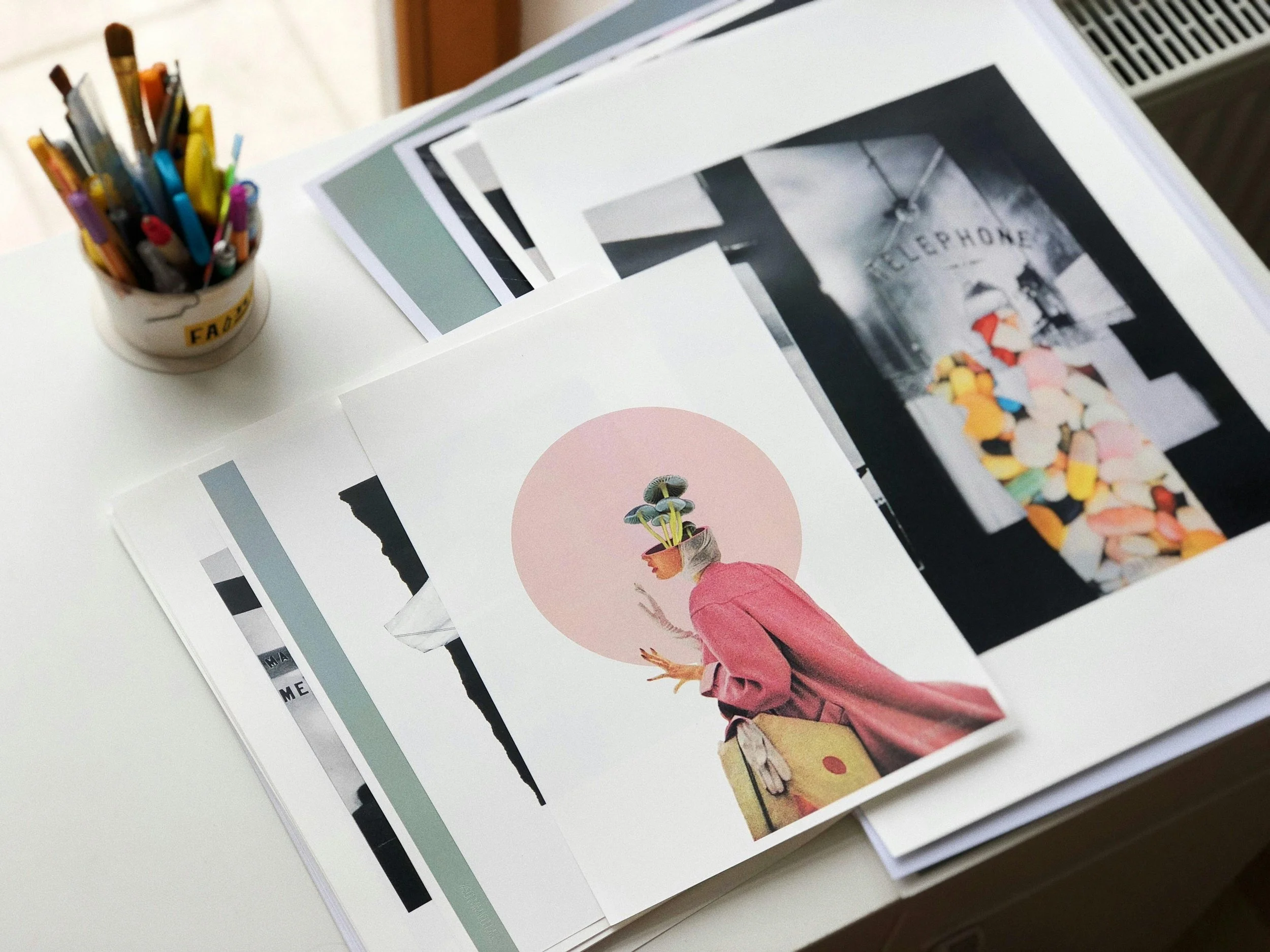
Pros of Having Multiple Vision Boards
When used intentionally, multiple vision boards can offer meaningful support.
One of the biggest benefits is clarity across different timeframes.A long-term board can hold your deeper direction without the pressure of immediacy, while a shorter-term board helps you get closer to your present season.
Multiple boards can also support psychological containment. If you’re navigating complex or emotionally charged work, having a dedicated board for that domain can prevent it from spilling into every other area of your life.
Other potential benefits include:
Allowing different parts of you to be expressed without compromise
Reducing overwhelm by separating broad vision from immediate focus
Supporting transitions, such as career shifts or life changes
Making invisible inner processes more tangible
For some people, especially those who think visually or intuitively, this separation can create a sense of spaciousness rather than pressure or limitation.
Cons of Having Multiple Vision Boards
At the same time, there are legitimate drawbacks to be aware of.
The most likely risk is attention fragmentation. Each board subtly asks for your energy, reflection, and engagement. If there are too many, none of them may receive enough depth to actually be meaningful.
Another challenge is internal contradiction. Separate boards can sometimes hold values or directions that quietly clash with each other. Without an integrative high-level overview, this tension can remain unconscious.
There is also the danger of turning vision boards into another productivity task. When creation becomes rushed or habitual, the practice loses its grounding quality. Creating vision boards shouldn’t be stressful or high-pressure.
This is something we make sure to keep in mind during our annual vision board-making workshops!
If you’re looking for a guided vision board-making workshop designed to be no-stress and supportive, check out our self-paced online Visioning 2026 Workshop.
Signs that multiple vision boards may not be serving you include:
Feeling pressured rather than supported by them
Rarely engaging with them after creation
A sense of confusion rather than clarity
Constantly wanting to “redo” or add more
If you notice these patterns, it may be time to simplify.
What To Include In Your Vision Board(s)
What you include matters just as much as how many boards you create.
Many people begin with images they already recognise from social media or advertising: their version of an “ideal” home, body, holiday, or lifestyle. While there’s nothing inherently wrong with these images, they often come from external conditioning rather than inner sensing.
In our approach, we begin somewhere else.
Before choosing any images, we invite people to sense into the qualities that would most support them in the time ahead. This might be joy, ease, courage, compassion, depth, or spaciousness.
From that place, creation becomes intuitive rather than strategic.
Instead of thinking your way through the process, you allow your hands to choose images that resonate. Often, the resulting collage doesn’t immediately “make sense” - and that is part of its power.
One example from my own experience illustrates this well.
In one of my vision collages, a compass appeared very prominently at the centre. At the time, I had no conscious plan to create an online programme, nor any clarity about what it might look like.
Only halfway through the year did I realise that this image had anticipated what later became the Changework Compass - a project I spent over 200 hours developing and running twice, with around 50 participants in total.
I didn’t think, “I want to build an online course, therefore I’ll put a compass on my board.” The image emerged organically from working with qualities rather than goals.
This is also why intuitive vision boards often feel alive long after they are created. They come from a much deeper place than rational planning.
Why Do Vision Boards Fail? How Can You Prevent Your Vision Board from Failing?
Vision boards usually fail not because they’re ineffective, but because they’re misused.
One common reason is creating them purely from the mind. When a board is driven by aspiration without embodiment, it can become disconnected from reality. It may look beautiful, yet fail to influence how you actually live. It’s important to consider your unique set of circumstances.
Another reason is lack of relationship. If a vision board is created once and then forgotten, it becomes static and, honestly, totally useless. Visioning is not a one-off event but an ongoing dialogue with the version of you that you want to step into.
Vision boards can also fail when they’re overloaded. Trying to include anything and everything at once often results in diluted meaning, focus, and attention.
To prevent this, consider the following:
Start with inner sensing, not the things society tells you that you should want
Focus on qualities before outcomes
Revisit your board regularly, without judgement
Allow it to evolve rather than insisting on permanence
We see intuitive vision boarding as a form of self-listening. In that sense, it’s a bit like being your own life director. You allow knowledge that already exists within you - subconscious, embodied, intuitive - to surface into awareness and real life.
Where Should I Put My Vision Boards?
Placement matters a ton because it shapes how you relate to your board. Some people prefer to place their vision boards where they’ll see them daily, like on their bathroom mirror or as their computer’s wallpaper. You could put a small one in your car, or even as your phone’s lock screen. Others find that too much visibility turns the board into background noise.
There is no universal rule.
You might experiment with:
Keeping a long-term board somewhere private and reflective
Placing a seasonal board in your workspace
Revisiting boards intentionally rather than obsessively
The most important thing is that your vision board invites presence, hopefulness, and optimism rather than crushing pressure. If looking at it makes you tense or self-critical, something needs adjusting.
How Can I Upgrade My Vision Board to the Next Level?
Upgrading your vision board doesn’t mean making it more impressive. It means making it more alive.
One powerful way to deepen the practice is to integrate reflection and ritual. This might include revisiting your board at the end of each month, or sensing into what has shifted without trying to evaluate success or failure.
You can also add a monthly journaling practice reflecting on your progress towards your goals. This adds another powerful dimension to your vision board.
Another upgrade is to work with process over product. The act of creating a physical vision board - cutting, arranging, gluing, sitting with uncertainty - is as important as the finished piece.
You can also bring your body into the practice. Notice sensations, emotions like fear and excitement, and resistance as they arise. These signals often carry more information than the images themselves.
Finally, consider whether your vision board is asking to be accompanied by other creative practices. Writing, movement, clay work, or sound can all help integrate what the board reveals. Adding different dimensions brings your vision board to life! Experiment with different mediums to find what you like the most.
At its best, a vision board is not a demand placed on the future. It’s a conversation with your present.
So, can you have multiple vision boards?
Yes - if they help you stay oriented rather than overwhelmed.
Yes - if they reflect your inner truth rather than external expectations.
And yes - if they invite curiosity instead of pressure.
If you feel drawn to explore visioning in a deeper, more embodied way, you’ll love this online Visioning 2026 Workshop. It’s guided, supportive, and self-paced so you get the best possible experience.
Vision boards should be accessible, gentle, and grounded - working with creativity as a way to reconnect rather than optimise. You don’t need more clarity. You need the right kind of listening.
And sometimes, one board is enough. Sometimes, two make sense.
What matters most is that your vision boards serve your life - not the other way around.

Hi there, so lovely that you're here! Looking forward to connecting with you. - Nora
