
Creating a writing routine is rarely about just flexing your self-discipline muscle. For many people, especially those who care deeply about the world, it’s about energy, meaning, and finding a rhythm that feels kind rather than constraining.
As a writer (yes, if you’re writing, you’re a writer!), you need a sustainable, nourishing, and adaptable writing routine - one that can evolve alongside you.
Before going deeper into the practical steps, it’s important to name something often left unsaid in conversations about how to create a writing routine.
There is no single ‘right’ routine.
A writing routine that supports a new parent will look different from one that supports a swamped university student, a full-time employee, or someone recovering from burnout.
In other words, a sustainable, feel-good writing routine is one that meets you where you are, not where you think you should be. And definitely not where anyone else is.
Why Most Advice on How to Create a Writing Routine Falls Short
Many people promise a “picture perfect” routine. Instagrammable. One that works effortlessly every day like clockwork.
You know - they suggest fixed word counts, early mornings, or long uninterrupted hours. But, for people already navigating full lives, emotional labour, or creative fatigue, this advice often creates pressure rather than momentum.
A writing routine doesn’t fail because you lack willpower - I promise. It often fails because it doesn’t fit your life, your nervous system, or your current season of life. That’s why other people’s advice can only act as guidance, not rigid rules.
Step 1. Get Clear on Your Most Powerful “Why”
Every meaningful writing routine begins with purpose. Without a clear answer to the question “why am I doing this?”, writing quickly becomes another procrastinated task on an already long to-do list.
Your “why” doesn’t need to be grand or public-facing. It simply needs to feel true, energizing, and powerful.
Reflect on What Writing Gives You
Are you writing a novel you hope to publish one day? Are you writing a self-help book based on your education and lived experiences? Go even deeper. Are you writing a book for others because you want recognition, validation, support, or confidence? Writing for income or to help others can be an extremely powerful “why”, but I encourage you to dive even deeper to truly get to the core.
Or is your writing practice more for yourself? To process emotions, cultivate creativity, or stay connected to something deeper? Writing for healing can also be an extremely powerful “why”. Regular journaling has been scientifically shown to reduce stress and anxiety. Your reason can change over time, and that’s allowed.
Regardless of your “why”, I recommend journaling to help uncover your truest motivations:
What does writing make possible for me that nothing else does?
When I imagine a life without writing, what feels missing?
When I’m done with my writing goals, how do I think I’ll feel?
Purpose is cyclical rather than fixed. We plant seeds, take action, harvest insights, and begin again. Your writing “why” can (and most likely, will) move through the same cycles. Change is good.
Anchor Your Routine to Identity
One of the most powerful shifts is moving from “I try to write” to “I am someone who writes.”
This identity-based approach is inspired by scientific habit research popularised by thinkers like James Clear, but it also resonates deeply on an emotional level.
Our identities shape our thoughts and beliefs, which in turn, shape our actions. By practicing this shift in how you think about yourself, you’ll feel much more aligned with taking your writing routine seriously. And, if you genuinely and sincerely want to write, then this step is essential.
When writing becomes part of who you are, not just what you do, showing up requires less negotiation and easier commitment.
Step 2. Decide How Many Days per Week You’ll Write (and Put Them in Your Calendar)
Consistency matters much more than intensity. A gentle, realistic commitment almost always outperforms an ambitious one that feels heavy or high-pressure.
We don’t want your stress or anxiety to go up, so I recommend focusing on the things you can control. Things like how often you sit down to write, how often you brainstorm topics, how often you research those topics, etc.
Choose Frequency Over Duration
Writing for 60 minutes, 3 times a week is more effective than writing for 7 hours once every 2 weeks. Small commitments equal lower resistance. They make starting (and sticking to it) a lot easier.
Ask yourself:
How many days per week feels easy to stick to?
What would still feel doable on a tired or emotionally intense day?
For many people, two to four days per week is a nourishing place to begin.
Make It Visible
Once you’ve chosen your days, time block them in your calendar. Whether you use a physical planner or a digital one like Google Calendar, treat them like important business meetings with yourself. Unless an emergency arises, this time is strictly non-negotiable.
Psychologically, seeing writing time scheduled reduces decision fatigue.It also sends a subtle message to yourself that this time truly matters.
Step 3. Treat Your Writing Days as Non-Negotiable (Because They Are)
Non-negotiable means you do it even when you don’t feel like it. Of course, don’t abandon your needs, but if you’re able to, you’re sitting down and attempting to write.
Honour the Commitment, Adjust the Scale
Life will still happen. Energy will fluctuate. What should stay consistent is the intention to show up.
On low-energy days, “showing up” might mean:
Opening your notebook.
Writing one sentence.
Sitting quietly with a pen for five minutes.
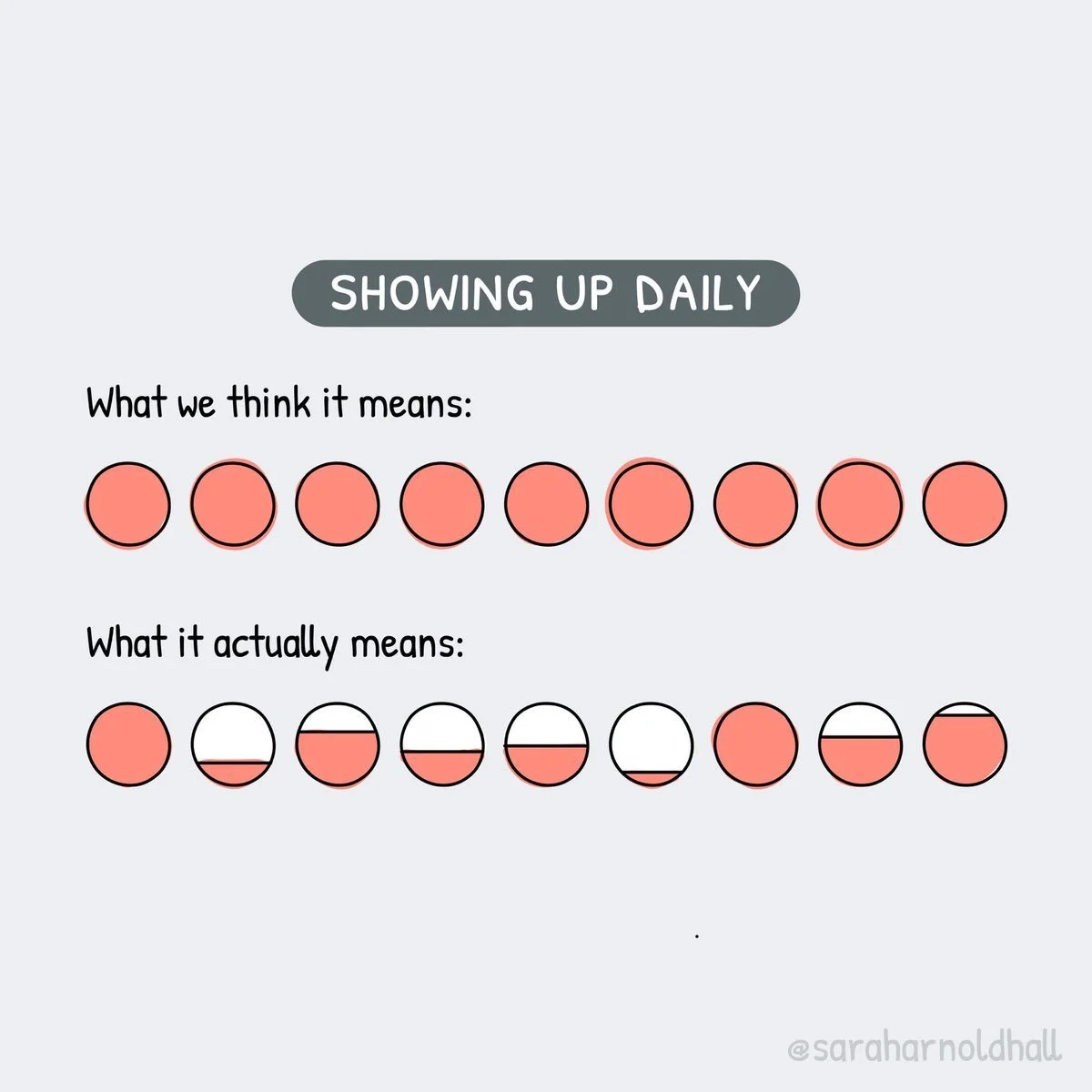
One idea I always say to people in your shoes: beginning is more important than completing.
Each time you show up, you reinforce trust with yourself. This builds confidence and inner strength.
Release the Myth of the Perfect Session
A writing routine is built through imperfect consistency. I know, easier said than done. But it’s through consistency that progress will feel like momentum and sitting down to write will eventually start feeling energy-giving and exciting.
You aren’t failing your routine when a session feels messy. You’re practising being someone who writes. This all ties back to including the descriptor ‘writer’ in your identity!
Step 4. Design and Organise a Dedicated, No-Distraction Writing Space
Your environment shapes your behaviour far more than motivation does. If you want to understand how to create a writing routine that lasts, I recommend starting with your surroundings.
Make Writing Obvious and Easy
A dedicated, intentionally-designed writing space uplevels your writing routine because you know you best. Do you work the best with 1 monitor or more? Do you need a pen and paper next to you to quickly jot down notes? Or maybe you thrive with 2 or more beverages (i.e. a hot tea, glass of water, and orange juice)?
Helpful elements might include:
A notebook or paper always open and ready
A pen you enjoy using
Soft lighting or natural light
A sense of visual calm like a photo of a calm ocean
When your tools are visible and accessible, starting requires less effort.
Reduce Decision Fatigue
If you have to decide where to write each time, you add unnecessary friction (which makes it feel harder to actually sit down and start each time). Returning to the same place that you intentionally designed creates a gentle, reliable ritual. Your body begins to associate that space with writing.
Don’t worry about making your writing space ‘perfect’. It doesn’t have to be Instagrammable or aesthetically pleasing to anyone else but you. It’s about building ease and support for yourself.
Diving deeper, if you want guided advice and a truly supportive community while you figure this out, sign up to our live 10-week online writing routine program. It’s expertly designed to help you create a writing routine that feels good - easeful, enjoyable, and sustainable.
Step 5. Create a Pre-Writing Routine
A pre-writing routine is a bridge to help you transition from the hustle and bustle of the day into a more focused, positive writing state.
Keep It Simple and Repeatable
Your pre-writing routine might take two minutes or fifteen. What matters here is (surprise!) consistency. The more you practice your pre-writing routine, the easier actually writing will be because your mind will associate it more and more with fluid writing.
Your routine could include:
Enjoying a cup of tea
Lighting a candle
Taking three slow breaths
Stretching
Applying moisturizer
Jumping up and down for a minute
Writing one “throwaway” sentence to get started
Over time, these actions become cues telling your nervous system it’s safe to create.

Start Before You Feel Ready
Waiting for inspiration often leads to waiting indefinitely. You’ve probably heard this before, but action creates momentum, not the other way around.
I always emphasize that starting small is key because it truly is. Five minutes of writing regularly is enough to keep the habit alive. That said, give yourself grace when you feel a lot of inhibition, fear, anxiety, or imposter syndrome. Those feelings are very valid and very normal for anyone in your shoes. You’ll have good writing days, and bad writing days. What matters is that you keep showing up.
Step 6. Reward Yourself After Each Writing Session
Science says that habits form easier when actions feel rewarding and worth it. This doesn’t necessarily mean giving yourself external prizes - it more importantly means noticing, acknowledging, appreciating, and validating all of your effort.
Choose Rewards That Feel Nourishing
A reward might look like:
Stretching or stepping outside
A delicious bar of chocolate
Texting a loved one
Dancing like no one’s watching
Booking yourself a massage or facial
Simply pausing to say, “I showed up today and I’m so proud of myself”
Baking chocolate chip cookies
Watching your favourite sports team’s game
Playing with your furry friend
Doing an elevated skin care routine
Going to the gym
Saying hi to your neighbour
The reward reinforces the behaviour. So it essentially tells your brain that writing is something you genuinely want to return to.
Over time, this shift is subtle but extremely powerful.
Step 7. Schedule Reading Time in Your Calendar
Writing doesn’t happen in a bubble. Regularly reading is part of the creative ecosystem. If you’re writing a book, maybe you need to read a lot for research. If you’re writing poetry, maybe you want to explore different poetic styles for inspiration. Pouring into your literary mind, not just extracting from it, can do absolute wonders for your writing routine.
Reading Fuels Writing
More specifically, reading expands language, stylistic opportunities, and inspiration. It also relieves pressure by reminding you that you’re part of a larger conversation.
I recommend scheduling reading time just like you schedule writing time. Use the time block method again to make reading time non-negotiable in your schedule. If you don’t plan for it, it’s unlikely (or much harder) to remember to do it.
Read With Curiosity, Not Comparison
Read to enjoy, to learn, to notice. Not to measure or compare yourself. If you feel like you’re dipping into comparing territory, it’s time to reorient your mindset. Everyone writes differently, so while yes it can be helpful to explore what’s out there, it’s definitely harmful to continuously compare yourself to others. This would only de-motivate you from writing.
Remember, no one starts as an Edgar Allen Poe or Agatha Christie. Every author you look up to starting exactly in your shoes. While so many others did, these successful authors never stopped writing.
When reading becomes a companion rather than a standard, writing feels lighter. Highly recommend!
Going further, if you want guided advice and a truly supportive community while you figure this out, check out our live 10-week online writing routine program. It’s expertly designed to help you create a writing routine that feels like you - steady, enjoyable, and sustainable.
How to Avoid Common Writing Routine Mistakes, Overcome Writing Block, & Navigate Writing Challenges
Unfortunately, even the most supportive routines can encounter friction. Below are 5 common challenges you may experience, and gentle ways to work through them.
1. Setting Goals That Are Too Big
While ambitious goals can feel inspiring at first, they often become paralysing over time. The pressure can add up until you don’t feel like taking any action. Sadly, this is where a lot of aspiring writers fall off. Their big dreams get overwhelming before they notice what’s happening and then they’re unable to get back into it.
If your writing routine feels overwhelming at the moment, reduce the goal. If you’ve been doing 4 days a week, reduce it to 3 and see how that feels. Smaller, more doable commitments can build confidence and consistency, and eventually, they’ll feel so small that you’ll be ready to add more onto your plate and feel good about it.
Working up to more is always better than starting with a lot, getting burned out, and then reducing or even eliminating.
2. Relying on Willpower or Motivation Instead of Structure
Willpower is finite. Motivation comes and goes. What’s reliable and holds up successful writing routines is structure and organization.
I want to emphasize again how important it is to design your environment and schedule so that writing feels completely doable, exciting, and sustainable. Let the system do the heavy lifting.
3. Expecting the Routine to Stay the Same Forever
Your life will inevitably change. Your writing routine should change with it. For example, if your partner’s work schedule changes and now there’s a conflict with your writing routine, it’s important to be somewhat flexible so that your writing doesn’t suffer.
Seasonal or monthly reviews help. Ask: What still works, and what needs adjusting?
4. Interpreting Resistance as Failure
Resistance is just information. It often signals fear, fatigue, or the need for gentleness and self-compassion.
Instead of ignoring those feelings or pushing through, get curious. What is your resistance asking for? Maybe your mind, body, or soul need something special. Or maybe you simply need a rest day.
5. Confusing Writing Block with Emotional Overload
What we call ‘writer’s block’ is often emotional saturation. When feelings are unprocessed, creativity struggles to move through you.
Short, low-pressure writing sessions can help you metabolise rather than avoid what’s coming up for you. Or you may need a break or a self-care day. Pushing through emotional overload will only hurt your writing because you’ll be writing from that place. Even if you’re good at compartmentalizing, it’ll still negatively affect your writing - the mind is powerful, but the subconscious can be more powerful sometimes.
Your Writing Routine Is a Relationship
Creating and following a writing routine is less about control and more about intention and care. It’s an ongoing conversation and relationship with yourself.
Some days, the entire routine will feel effortless. Other days, simply showing up is enough.
Here at the well, we often speak about tending rather than forcing. A person’s well does not refill itself through pressure or fear. It refills through attention, patience, self-compassion, and coming back to your ‘why’.
Remember, your words matter, even when no one else sees them. Showing up to practice your writing routine is showing up for your goals, your dreams, and yourself.
As you continue shaping your own writing rhythm, also don’t forget:
You are allowed to move slowly.
You are allowed to change your mind.
You are allowed to create a routine that feels good to you, not to anyone else.

Hi there, so lovely that you're here! Looking forward to connecting with you. - Nora
